

Document requests. Ask an applicant for documents through a secure link, or in an iframe in your own app:
POST /v1/requests and GET, revoke and resend under it, with the scopes requests:write and requests:read. The applicant accepts the privacy notice, uploads the documents you asked for and submits. Four new webhook events, request.opened, request.submitted, request.completed and request.expired, carry ids and statuses only. You choose the frame origins and the reply-to address in the workspace’s request settings. See Document requests.KYC policy parameters. A workspace admin can now set, per client kind and environment: what a duplicate document does (duplicate_document_action, duplicate_hamming_threshold), how closely names must match across documents (name_match_threshold), a maximum age per document type (max_document_age_days_by_type), a minimum applicant age and a maximum ID age (min_applicant_age_years, max_id_age_years), what a fake-image hint does (fake_image_action), what a sanctions or PEP hit does and the name-match score that counts as a hit (sanctions_pep_action, sanctions_name_match_threshold), and how strict the face checks are (liveness_strictness). The defaults are the previous behaviour. See KYC policy and document integrity.Document integrity. Documents read in the console are inspected for how the file was made (editing software, dates, re-saves, camera data, screenshots, fonts), and a picture already used on another case of your workspace is flagged as a duplicate or near-duplicate. Pixel-level fake-image hints are added to photographs. They are reasons to look, not refusals.Registry checks. The console’s Integrations page, and now the API, check a French SIREN or SIRET (open state directory), an EU VAT number (VIES), a LEI (GLEIF), an IBAN from any country, a Moroccan RIB and a Moroccan ICE. The IBAN, RIB and ICE checks validate the number only, and no Moroccan registry is queried. See Registry checks.Rate limit per key. Calls with an API key are now counted per key: 300 a minute, instead of 100 a minute per client IP. The KYB, statements, webhook and document request routes keep their own limit of 60 a minute per key. See Authentication.Partner API 2. Seven new scopes (registry:read, cases:read, scoring:read, scoring:write, policy:read, policy:write, usage:read), 18 in all, and the routes behind them, all under /v1/partner:registry: SIREN or SIRET, EU VAT, LEI, IBAN, Moroccan RIB and ICE checks. Registry checkscases: list and read cases, their documents and extracted fields, and download the original file. Cases and documentsscoring: read a case’s 0 to 1000 score by yourreference, run it again, and simulate another loan, weights or thresholds without saving. Scoring by APIpolicy: read the KYC policy, save a new version and list the history. A key can add locks and tighten values, never remove a lock. Policywebhook-deliveries: the delivery log, a 24-hour and 7-day summary, and a replay with the sameX-Sahl-Deliveryid and a fresh signature. Webhook endpointsme,usage,request-logs,errors: what your key can do, your document quota and call counts, your key’s recent calls, and the error catalogue. Account, usage and errors
- A new workspace needs a work email (not Gmail, Yahoo and similar).
- The applicant page of a document request shows a verification challenge before consent.
- The verification widget can be embedded from any https site.
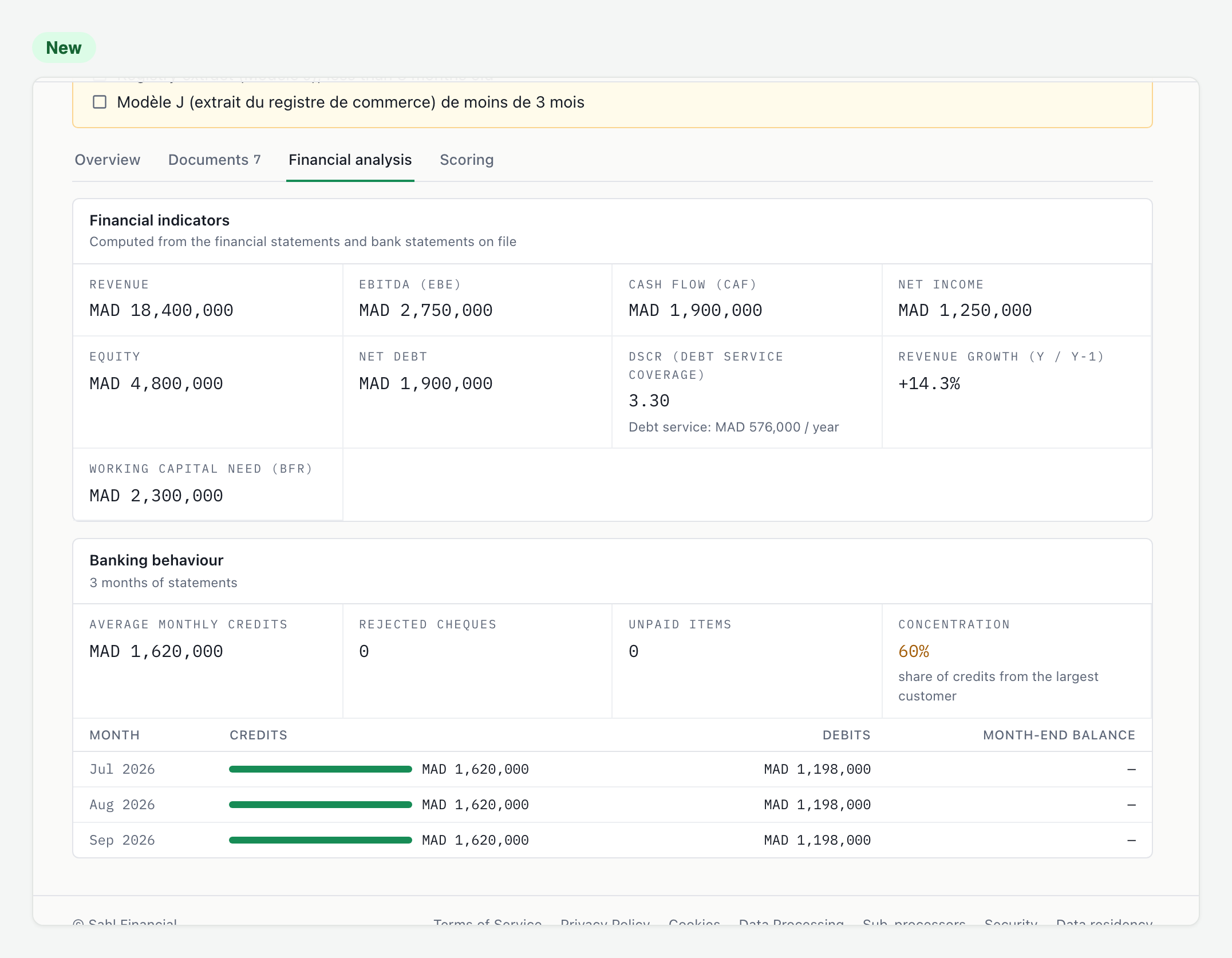
SME credit. A company case is now scored as a company: the SME score reads the liasse (N and N-1), the repayment schedules and the bank statements. It has six blocks: repayment capacity (DSCR, EBITDA margin, cash flow), financial structure, banking behaviour, business activity, credit incidents and KYB compliance. A missing figure is “not computed” and the score is renormalised on the rest, never counted as 0. Hard rules block a file whatever the score: DSCR below the floor (a Sahl parameter, 1.20 by default), a payment incident, a sanctions match, negative equity, a company struck off or in collective proceedings. Each file gets a one-paragraph credit summary in French and English.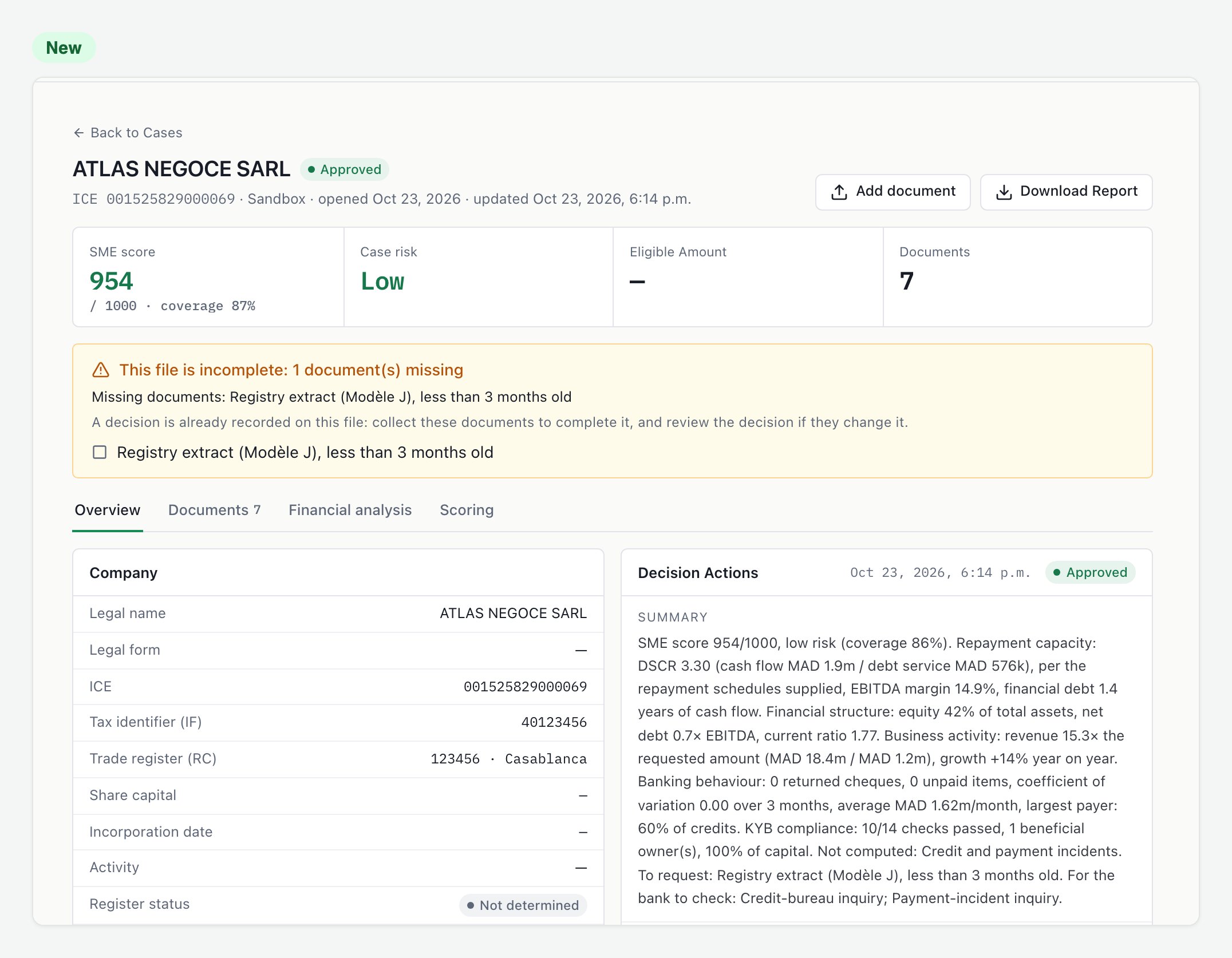
- A blurry photo of a CIN or a passport uploaded without a type is now recognised as such, instead of being read as a bank statement.
- Moroccan workspaces read documents in French by default.
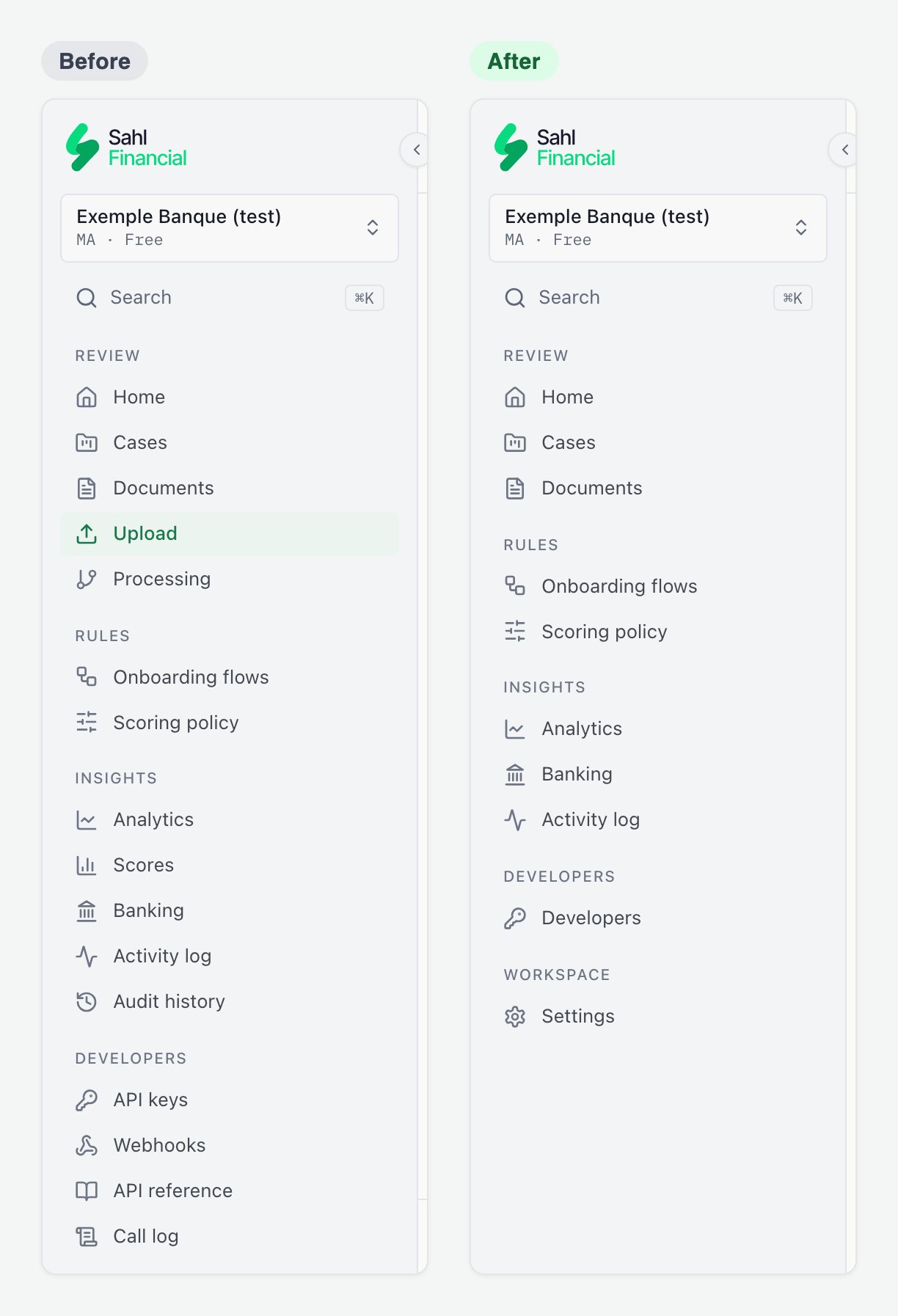
- API keys and webhooks moved from Settings to Developers; old links still work.
The Sandbox reads specimen documents only. From 24 October 2026, a new workspace’s Sandbox reads only Sahl’s specimen documents, or documents that print SPECIMEN, in the console, the verification widget and the API. A real document gets 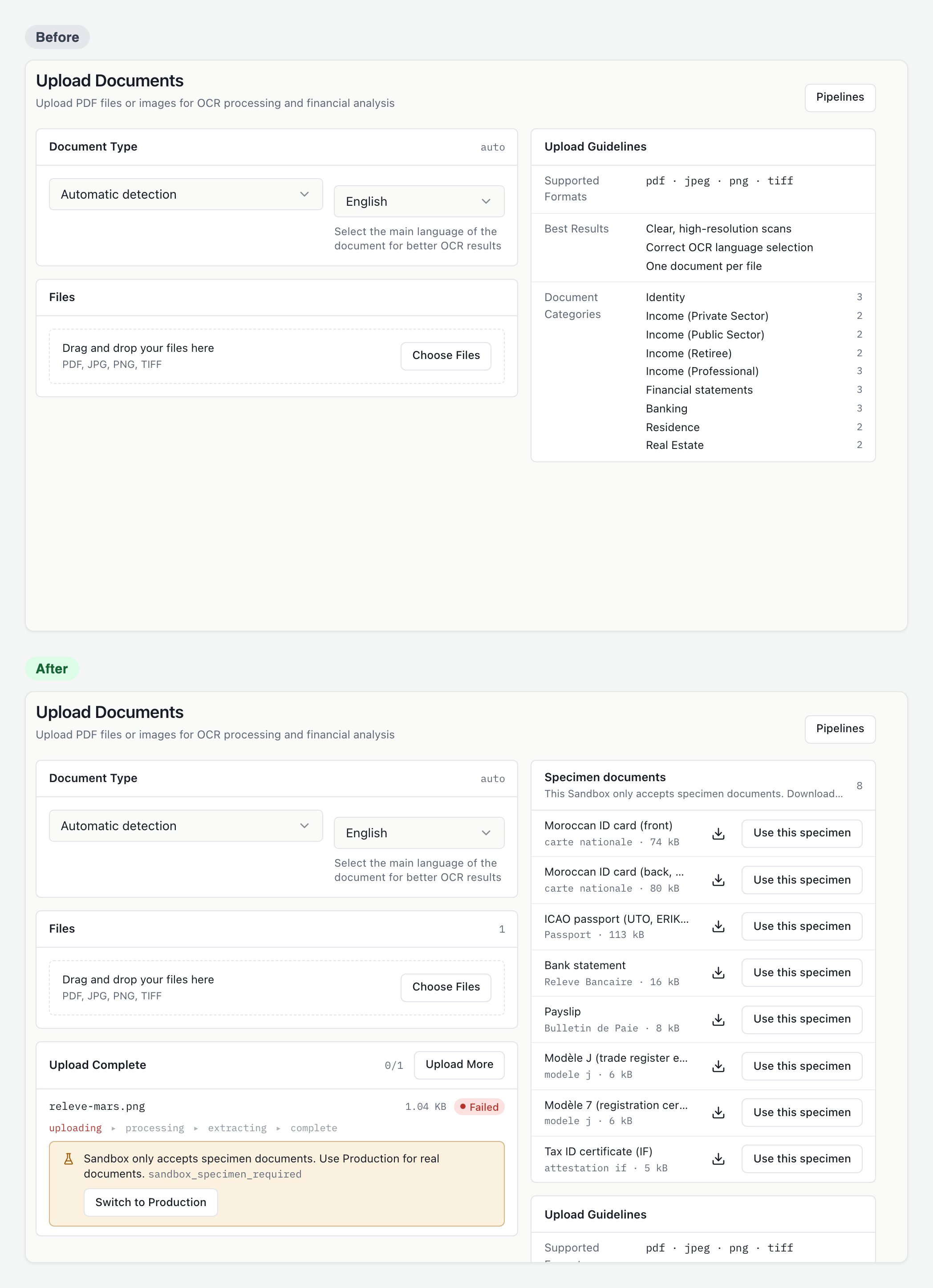
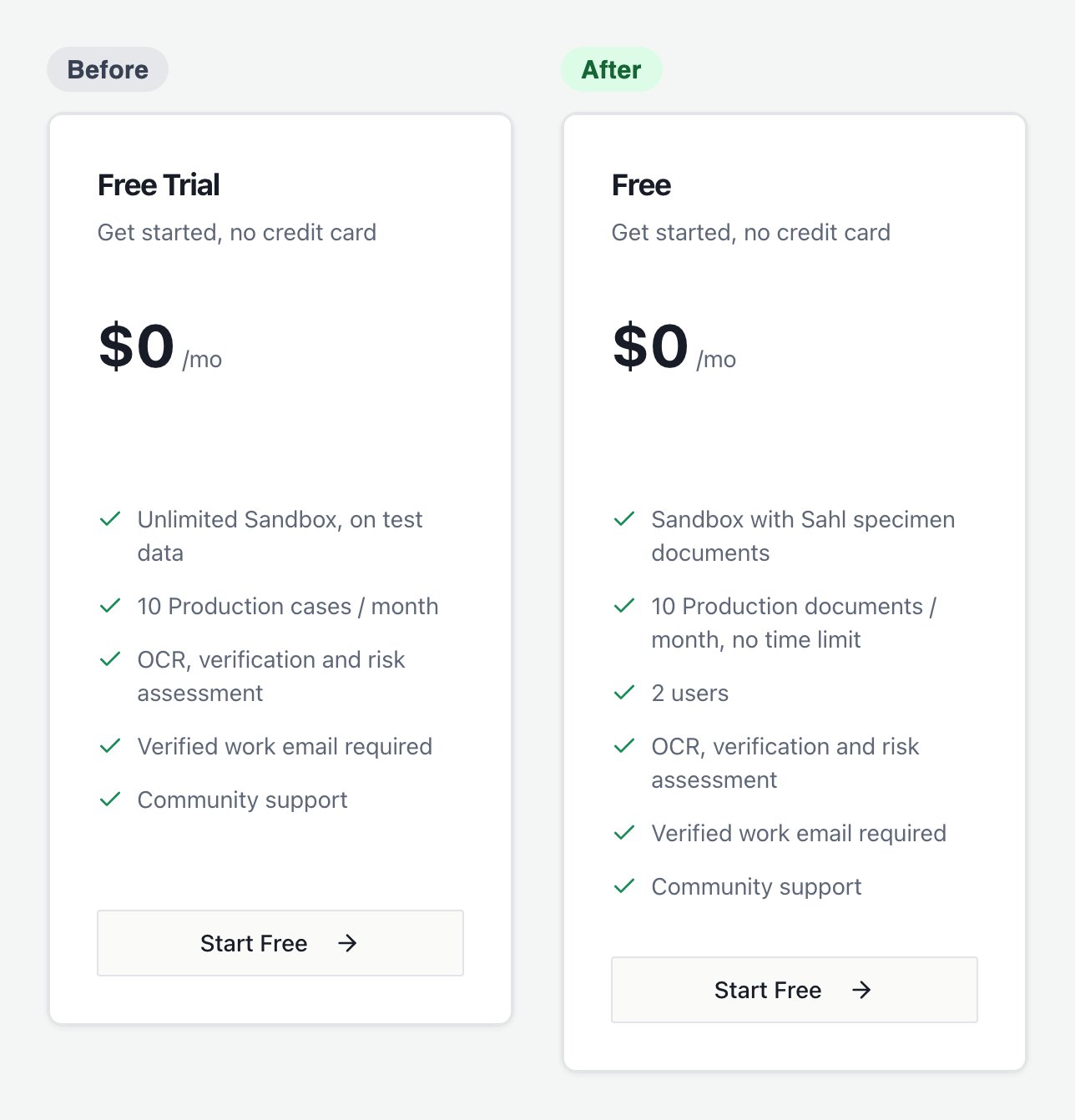
422 sandbox_specimen_required, and nothing read from it is returned or kept. The specimens are on the Upload page and at GET /api/v1/sandbox/specimens. Real documents go in Production. Workspaces created before 24 October keep the Sandbox they had. See Sandbox and production.- The document quality score is computed by the API and kept with each read, so the console and the API show the same score.
- Passports: each MRZ field is boxed where it was read. A misread country code is corrected only when exactly one valid code fits; otherwise, and when the name split is uncertain, the document goes to review.
- The sign-in page logo and a new “Back to the website” link go to sahlfinancial.com.
The samples in the guides, recipes, walkthrough, OpenAPI file and Postman collection now use Morocco: country
MA, a CIN national ID, Casablanca addresses and amounts read as MAD. Outputs were regenerated from the engine. Where the engine only handles Canada (eID) the samples still use CA. The API itself did not change.Full audit of the newest API code (199 operations with every flag on, 10 callable with an API key, 6 published). New pages: Console features and Coverage. The API itself did not change.
Sandbox testing from the docs (playground examples on every operation), a Postman collection and environment, an end-to-end walkthrough, recipes, a verification and risk-assessment reference, an eID guide, an error catalogue, a go-live checklist and a glossary. The OpenAPI file now types every 200 response and lists the errors the code raises. The API itself did not change.